Tuesday, June 18, 2013

Venn Passage 06.08.2013


In leaving Pillsbury Cove heading to Dundas Island, we crossed Venn Passage and then out into Chatham Sound.

Venn Passage is just 3 miles west of Prince Rupert.  This passage is narrow with strong currents and shortens the route to Chatham Strait for us northbound boats.  The passage is marked by a couple of ranges and several buoys.  Bruce carefully plotted out our course the night before we left to make sure we could identify turning points and line up with the range marks.  While Bruce piloted the boat, I stood on the deck with the mast to my back so I could line up the boat with the range marks and tell Bruce to steer either to starboard or port to align us to the range marks.  Range marks (for our non boating friends) are when you have a stationary mark on land and you line up another mark so the two separate markers are lined up on top of each other when you are correctly aligned in the channel.  This aid to navigation is used when you have unusually shallow water or rocks/shoals that you need to steer clear of.  Always interesting when you have to use this type of navigation!

Here is a sample of what range marks look like:


We picked up Stan on motor vessel “True Love” while in Prince Rupert.  Stan is traveling on his own from Prince Rupert to Ketchikan and wanted to be the trailing boat.

Saturday, June 15, 2013

Pillsbury Cove, BC 06.07.2013

Ron & Lynn decided to anchor out in Pillsbury Cove for the evening of Thursday 06.06, so after Bruce finished his workday we met up with them on Friday 06.07.

This cove is just 3 miles SW of the PRR&YC marina and is a bay to anchor for the night before setting off on our first of two legs to Ketchikan Alaska.

At the time we set the hook it was blowing SE 20-25 knots and was to lighten up throughout the night.


We got ready to row over to Contessa for a captain’s meeting and we found the dinghy completely full of water from all the rain while we were in Prince Rupert!  As I have rain boots it was only fair that I pump out the dinghy!  If you look closely you will see that we had water all the way up to the bottom of the seat! OMG!


Waiting out the weather in Prince Rupert

Due to weather out in Chatham Sound and Dixon Entrance we stayed in Prince Rupert for three nights.  Dixon Entrance is the second of the two main bodies of open water to be crossed on the Inside Passage.  This body of water marks the international boundary from Canada back into the United States and Alaska!  Due to strong and confused tidal flows and complex wind and weather fronts, nasty chop or breaking waves can develop – so we are waiting to cross during benign weather.  It looks like the weather may break for a good crossing on Sunday.

Boy did it rain in Prince Rupert!!  We really got use of our rain gear during this stay.

We stayed in Cow Bay which is has some shops and some good restaurants all within walking distance from the marina.  To get to the downtown area you have to walk up hill but at least bringing your purchases back to the boat was all downhill!

Because this is town caters to the commercial fishing fleet, the Petro-Canada fuel dock next door to the marina where we were staying has a station on the end of their fuel dock for changing the oil on your boat!  How convenient! 

As noted earlier in our blog, we changed out our motor on the boat the winter before last and as we now reached 100 hours on the new engine it was time to change the oil.

So you pull up to the oil changing station on the dock, had them delivered two five gallon buckets of oil by crane to the boat and away we went.  There was an oil depository for the old oil right there on the dock and we were in and out in less than an hour!  Kind of like going to Jiffy Lube but for the boat!

Early one evening while in Prince Rupert we heard a big explosion like a transformer box exploding and then the sirens started.  Looking out over the stern of our boat we clearly saw very black smoke.  At first we thought this might be a house fire but then the black smoke got blacker and billowing over the hillside.  We found out the next morning that a fire broke out in an industrial storage unit and the fire department had a problem getting the fire under control.  The black smoke was caused by the industrial chemicals and the explosion was propane tanks exploding.


One afternoon while we were in town, Bruce & I took the local bus and headed out to explore the North Pacific Cannery (NPC) which is a national historic site located south of the village of Port Edward on the Skneena River.

The cannery was established in 1889 and was the longest running cannery on the west coast finally closing in 1981.  At one time there were over 200 active salmon canneries in BC!

The cannery was built on pilings so no matter what the tide, a fresh catch could be delivered to the cannery and processed in a timely manor.

Walking on a tour of the cannery was fascinating!  We got to see all of the old canning equipment and how it actually worked.  Learned about how new technologies of the time transformed the industry and the workforce beginning with the manual canning lines through the introduction of mechanized canning lines.

Some time was spent learning how the fishermen tended their nets which were stored and mended in “Net Loft’s” and walked through the bunkhouses for the various workers, Chinese Bunkhouse, First Nations Houses, European Housing and the Manager’s & Asst Manager’s Houses.  It was very apparent the status of each of the classes of workers when you saw their housing.

And the company store still has many of the supplies that were left when the cannery was closed.  It was fun to see all of the old contents of the store and guess how some of it was used!  Including the ledger that the company store clerk used to keep track of the purchases made by the employees at the cannery.  At the end of the season the total owed to the company store was deducted from the employees pay, in some cases the employees owed more than their wages at the end of the season!    

Here is a picture of one of the old buildings that I believe was used for storage on a piece of the boardwalk that remains:


It would be interesting to go back for another visit in a few years and see how much further along they are in rehabbing the building and fixing equipment.

Tuesday, June 11, 2013

Prince Rupert, BC 06.04.2013

Underway at 8:45am PT for a good run up to Prince Rupert.  SE wind with just the right ebb – we never saw less than 8 knots all day.  We’re staying at the Prince Rupert Rowing & Yacht Club (PRRYC)in Cow Bay which is at the north edge of town. 


Weather may keep us here for a few days, but this appears at first glance to be a nice place to stop.  Bruce ordered some supplies that he had delivered to the Volvo dealer here in town so we’ll have to figure out where the dealer is and make arrangements to get there.


Nettle Basin, Lowe Inlet 06.03.2013

We left for the next leg early proceeding north past Butedale up Fraser Reach through McKay Reach across Wright Sound then into Grenville Channel.  Long day of motoring but a fabulous anchorage at the base of Verney Falls. 


At Butedale there is a great water fall.  And with the morning sun shining on the small cannery it was so pretty.  On the way back down it would be nice to stop here and walk around.


 We arrived early in Lowe Inlet into Nettle Basin and decided to set the anchor at the base of Verney Falls.


 One of the many marine guide books we have been using is “How to Cruise to Alaska Without Rocking the Boat Too Much” by Walt Woodward.  Mr. Woodward suggested something a little “different” in anchoring at Verney Falls.  So we decided to give it a try:

“Steer slowly right for the falls with your depthfinder on and a member of the crew (Ronnie) up on the bow, ready to release the anchor at the captain’s (Bruce) “command” [Bruce LOVES this book!! lol!].  Keep coming for the falls, staying in the river’s stream, until the depthfinder tells you that there are about three or four fathoms (18’ to 24’) under your keel.  Have the crew let go of the anchor while you take the boat out of gear.  “Order” enough scope for a three-to-one ratio.  The anchor will grab and the river’s stream will set it for you.  And, for as long as you wish, your boat will stay there with its bow pointed at the falls….  You won’t move an inch.”

We gave this a try and it was actually as easy as Mr. Woodward said! And it was a wonderful set on the anchor!


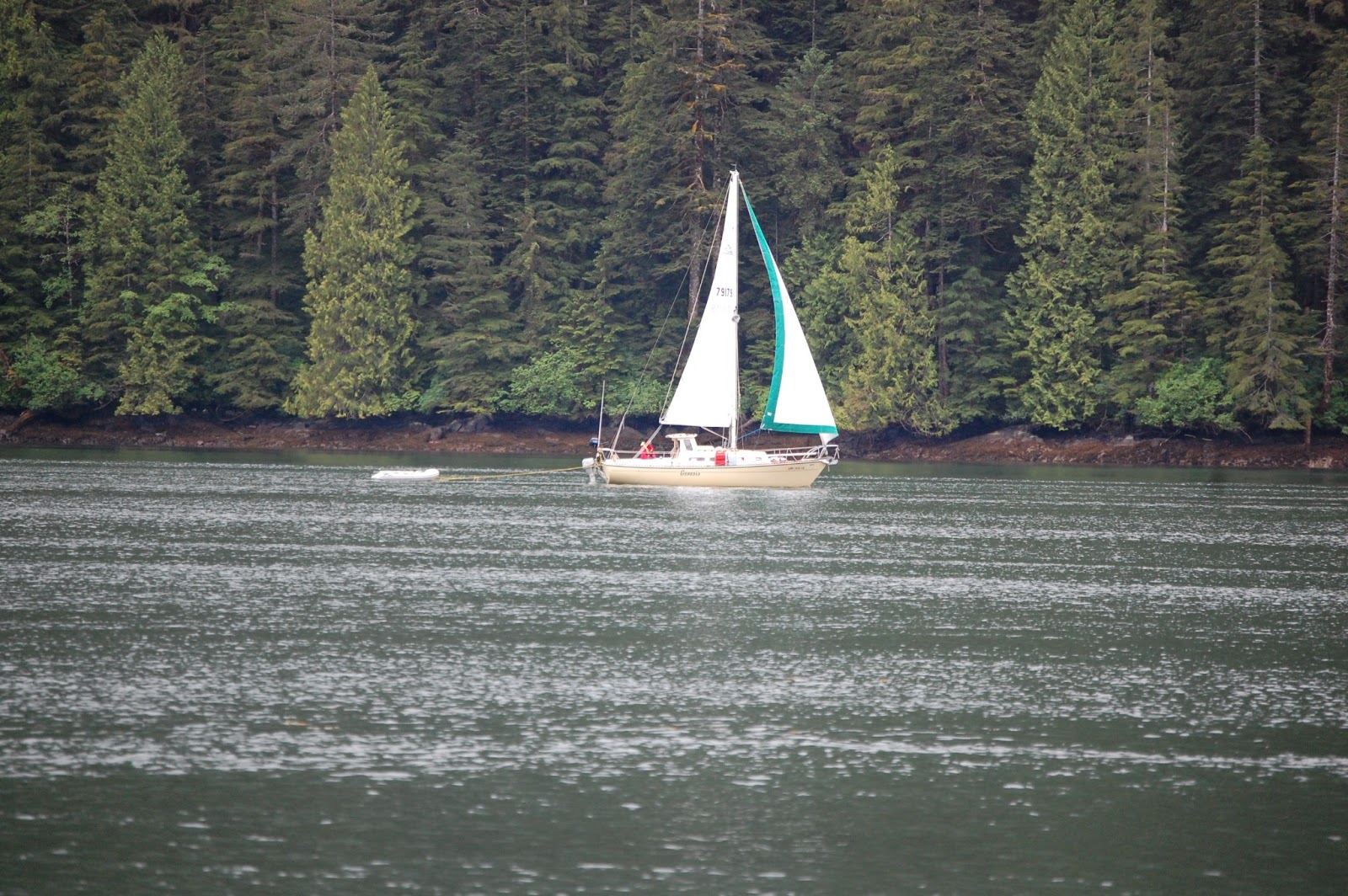
When we pulled up to the falls there was a sailboat already anchored to the side of the falls.  A 26’ sailboat named “Genesis”.  Her captain is Alan who is a professional photographer who is sailing up to Alaska for the first time.


As we arrived at the falls early in the afternoon we were able to invite Alan and Ron & Lynn over to our boat and enjoy a nice sunny afternoon on the back deck.  We had some warm crab dip and enjoyed the company.

We were also able to take Ron & Lynn’s dinghy, which has a motor, and ride up into the base of the falls!


We have read the when the salmon are running at Verney Falls you can watch bears feeding at the falls!  We were really hoping to see at least one bear but no luck so early in the season.  Maybe we’ll be able to stop back here on the south bound trip to see the bears.

Khultez Inlet 06.01.2013

This short 27 mile run up the reach was a pleasant morning hop from Bottleneck Inlet.  Not a cloud in the sky.


WOW what a beautiful anchorage! 


The waterfall at the head of the inlet reminds us of Chatterbox Falls in Prince Louisa Inlet. 


We set the hook in 60’ and put out ALL our rode for the first time.  We have 180+ feet of rode + 40 feet of 3/8” chain for a total of 220+ altogether.


Bruce and Ron caught 2 rock fish for the crab pots and Lynn and I prepared a wonderful crab fettuccine for dinner using the crab.  We ate like kings and still have the large crab from the crab legs to dip in butter another day!


Planning on Nettle Basin, Lowe Inlet tomorrow, which will make this a long 50 mile run.


Friday, June 7, 2013

Largest Crab Ever!! 06.02.2013


Leaving Bottleneck Inlet Ron picked up his crab pot and caught the two largest crab ever!  He had to put them in two separate buckets they were so big!  Over 10 inches!!


These are five gallon buckets!


Can’t wait to eat them!